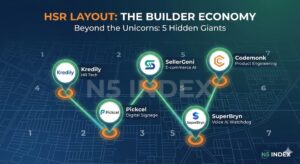
5 HSR Startups Defining the (080) Builder Economy
Company Overview
If you walk down 27th Main in HSR Layout, it is easy to get blinded by the logos. You see Udaan. You see Cure.fit. You see the massive glass facades of Sector 7 that house India’s newest unicorns.
We previously covered this phenomenon in our report on Why HSR Layout is the New Silicon Valley of India, analyzing how the neighborhood replaced Koramangala as the default HQ for high-growth tech.
But there is a second, less visible layer to the HSR economy. Tucked away in the quieter grid roads of Sector 2 and Sector 4 are the “Silent Giants”—companies that are either bootstrapped, capital-efficient, or building unsexy infrastructure that powers the rest of the ecosystem.
While Hebbal is attracting the DeepTech heavyweights and Indiranagar is chasing the D2C consumer, HSR remains the engine room. It is where the “Builder Economy” lives.
Here are 5 HSR-based startups that prove you don’t need a SoftBank check to win.
1. Kredily: The Freemium Disruptor
- Sector: HR Tech / FinTech
- Location: HSR Layout
In a market crowded with expensive HR software (Darwinbox, Keka), Kredily did something radical: they gave the software away for free.
The Business Model Innovation: Most SaaS companies charge a “Per Employee Per Month” fee. Kredily flipped this script by offering a robust “Free Forever” plan for payroll and attendance. Instead of monetizing the software, they monetize the employee.
- By acting as the gateway to an employee’s salary data, Kredily can offer financial products like loans and insurance directly to the workforce.
- This “B2B2C” model allowed them to acquire over 20,000 SMB clients without the massive sales burn that kills most SaaS startups.
The “Location-Smart” Tech: Operating out of HSR, they built a “Location-Smart” payroll engine that automatically calculates taxes based on the user’s specific geography—solving a massive compliance headache for Indian SMBs. Kredily is a classic example of HSR’s “Product-Led Growth” DNA: build something useful, give it away, and find a smarter way to monetize.
2. Pickcel: The “Boring” Global Giant
- Sector: Enterprise SaaS / Digital Signage
- Location: HSR Sector 2
You have likely stared at a Pickcel Digital Signage product without knowing it. Whether you are shopping at a Decathlon store, checking into a hotel, or looking at a flight display at an airport, there is a good chance Pickcel is powering the screen.
Why They Matter: Digital Signage is not “sexy.” It doesn’t get written about in TechCrunch. But it is a massive, critical global industry.
- The Decathlon Win: Pickcel powered the digital transformation of 200+ Decathlon stores across India, allowing the retailer to run instant promotions on screens nationwide from a single HSR office.
- The Client List: Their client roster includes heavyweights like Nissan, Mercedes-Benz, and Etisalat.
While other startups burn cash chasing “Community” or “Web3,” Pickcel has quietly built a global enterprise SaaS business by solving a boring problem—managing TV screens—exceptionally well. They represent the “Silent SaaS” tribe of HSR: profitable, product-focused, and global from Day 1.
3. SellerGeni: The AI Arbitrage
- Sector: E-Commerce Enabler / AdTech
- Location: HSR Layout
If you are selling on Amazon today, “organic” reach is dead. You have to pay to play. That is where SellerGeni steps in.
The Problem They Solve: Managing Amazon Ads is a nightmare of spreadsheets and bid adjustments. SellerGeni built an AI “Growth Manager” that automates this entirely.
- Their engine analyzes competitors, keywords, and bid prices in real-time to ensure sellers don’t waste money on clicks that don’t convert.
- They claim to reduce “wasted ad spend” while scaling revenue—a value proposition that is recession-proof for D2C brands.
The Market Signal: Founded by Athmajith Colote and Pramod Pavuluri, SellerGeni raised a seed round of ~$642K. They are distinct from the “Aggregators” (Thrasio-style models) that crashed in 2024. SellerGeni is a tool provider, meaning they make money regardless of which brand wins the category.
4. SuperBryn: The DeepTech “Watchdog”
- Sector: Voice AI / DeepTech
- Location: HSR Layout
While HSR is known for SaaS, a new wave of AI infrastructure is emerging. SuperBryn is the newest star on the block, having just raised $1.2 Million in December 2025 from Kalaari Capital’s CXXO initiative.
The Thesis: Everybody is building “AI Agents” (Voice bots that talk to you). But most of them break. They hallucinate, they get confused by accents, or they loop endlessly.
- SuperBryn’s Pitch: They don’t build the agent; they build the watchdog. Their platform monitors AI voice agents in real-time to catch failures before the customer gets angry.
- The Founders: Nikkitha Shanker and Neethu Mariam Joy pivoted 5 times before finding this “Reliability Layer” thesis.
Their presence in HSR signals a shift: the neighborhood is evolving from “Workflow SaaS” (CRMs, Payroll) to “Infrastructure AI” (Tools that keep AI running).
5. Codemonk: The Builders’ Builder
- Sector: Product Engineering Services
- Location: HSR Layout
In a gold rush, the surest way to make money is to sell shovels. Codemonk is the premium shovel seller of HSR.
The Model: They are a “Product Engineering” firm, but they operate like a startup. Instead of just taking orders, they help high-growth companies like Unilever, IndiaMART, and Skylark Drones build complex tech stacks.
- Why it works: Many HSR founders bootstrap their own product ideas by running a service agency like Codemonk on the side. It provides cash flow, keeps the engineering team sharp, and funds R&D without dilution.
- The Culture: With an 80+ member team, they have built a culture of “Own it, Lead it,” attracting engineers who want to work on diverse problems rather than being stuck on one feature for years.
The “Productive Density” of HSR
Why do all these companies cluster here?
Urban planners call it “Productive Density”.
- The Grid: Unlike the chaotic sprawl of Whitefield, HSR’s planned grid system (Sectors 1-7) allows for easy serendipity. You can walk from a VC meeting at Third Wave Coffee to a candidate interview at Starbucks in 10 minutes.
- The Talent: HSR has the highest concentration of software engineers in Bangalore. For a company like SuperBryn or SellerGeni, this means the cost of hiring is lower—the talent lives two streets away.
The Verdict: If you want to raise $100M and be famous, go to Sector 7. If you want to build a profitable, enduring engine that solves real problems? Look at the quieter lanes. Look at Kredily. Look at Pickcel.
HSR isn’t just a location; it’s a blueprint for how to build.